
A leaking diaper at 2am is enough to turn a quiet night into a full clothing and bedding change within minutes. For many parents, that is the point where they realise not all disposable diapers perform the same, especially overnight or in warmer weather. Choosing the right disposable diapers in Kenya makes a bigger difference than most people expect, from leak protection and absorbency to comfort during long hours of wear.
Why Disposable Diapers Are the Practical Choice for Kenyan Families
Kenya’s urban reality makes cloth diapering harder than it sounds. Water supply in Nairobi isn’t always reliable. Drying time during the long rains is a genuine problem. For parents in Westlands, Kasarani, Eldoret, or Kisumu balancing work and childcare, disposable diapers solve a real daily challenge, not a luxury one.
Good disposable diapers in Kenya keep a baby dry for up to 12 hours without requiring washing infrastructure. A newborn needs 8 to 10 changes a day in the first weeks, which drops to 5 to 6 changes by three months as feeds space out. Having a reliable disposable means you can focus on your baby rather than a constant laundry cycle.
The environmental side of the discussion is more complicated than people sometimes present it. A well-fitting disposable diaper that lasts properly through the night can reduce leaks, clothing changes, and unnecessary replacements, while cloth diapers often require repeated hot-water washing and indoor drying, especially during colder or rainy periods. Neither option is completely impact-free, which is why practicality, comfort, and consistency usually matter more than trying to find a perfect answer.
What Makes the Best Diapers in Kenya Worth the Price
Walk into any Carrefour or Naivas and you’ll see a wide range of baby nappies in Kenya at very different price points. The cheaper options can look nearly identical to premium ones on the shelf. They’re not.
The gap shows up at night and during runny messes. Budget diapers often have a thinner absorbent core that saturates faster, leading to more frequent changes and a higher actual cost per dry hour. They can also have weaker leg cuffs (those small raised barriers at the thigh opening) which are the main thing standing between a loose stool and your baby’s clothing.
The best diapers in Kenya share a few things: a multi-layer absorbent core that draws moisture away from the surface, breathable outer layers (important in Kenya’s heat — a non-breathable backsheet traps warmth and causes rashes faster), a stretchy waistband that moves with the baby rather than cutting in, and leg cuffs that hold their shape after several hours of movement.
NipNap’s disposable diapers use European raw materials and a 3D absorbent core specifically designed for extended overnight dryness. The brand is made locally in Thika — which keeps prices competitive and supply consistent across Nairobi and upcountry towns. You’ll find them at nipnap.co.ke as well as at Carrefour, Naivas, Mydawa, and Greenspoon.
Diaper Sizing in Kenya — Getting the Fit Right
Most diaper packaging shows an age range, but age is a rough guide at best. Weight is the metric that matters. Two six-month-olds can be two kilograms apart, and a diaper that fits one perfectly will leak on the other.
Here’s how NipNap’s sizing works for diapers in Kenya:
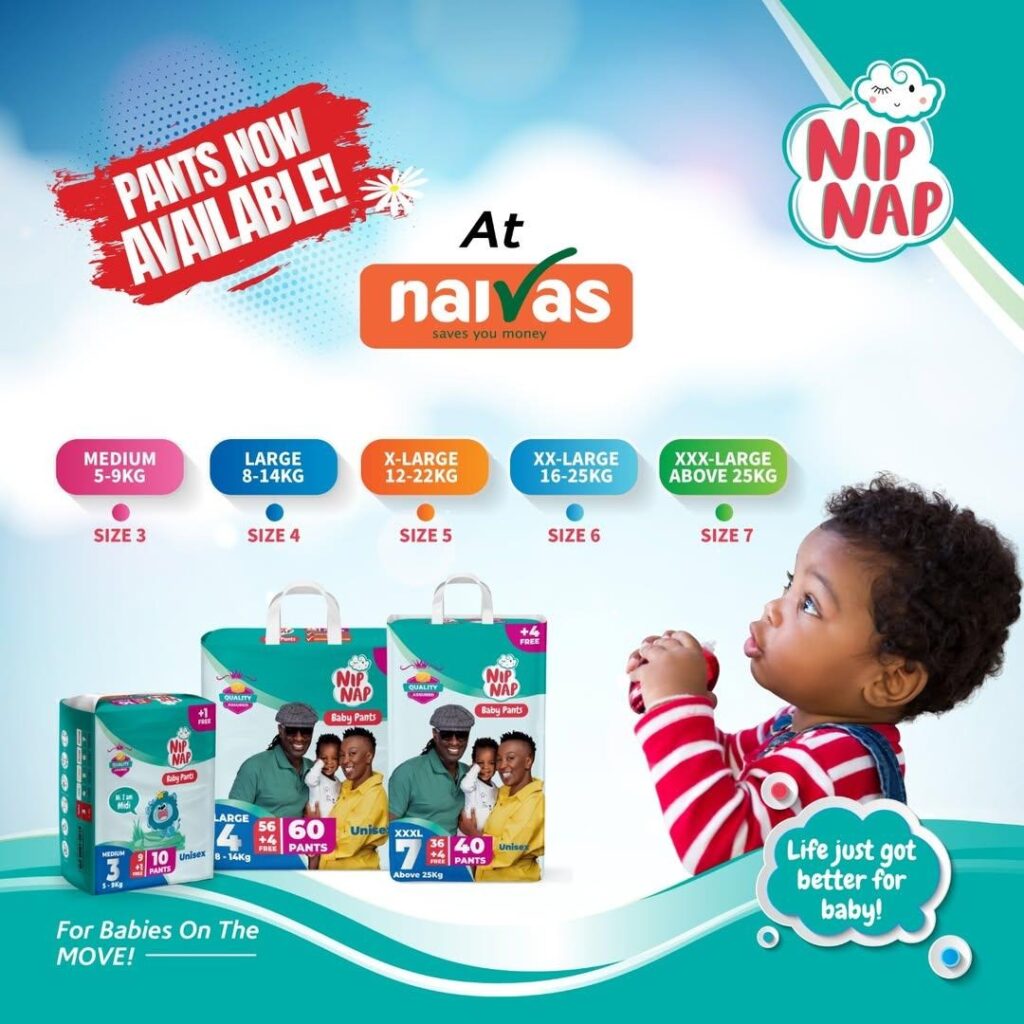
Size 1 (Newborn) covers babies from 2 to 5 kg — the first weeks, when changes are frequent and the baby barely moves. Size 2 (Mini) fits 3 to 6 kg, typically the first two to three months. Size 3 (Midi) covers 5 to 9 kg and is where most parents spend the longest stretch — roughly four to nine months. Size 4 (Maxi) fits 8 to 14 kg, usually nine months onwards. Size 5 (Junior) handles 12 to 22 kg for active toddlers.
If you’re between sizes, go with the larger one. A slightly bigger diaper can be adjusted; a slightly small one digs into the thighs, restricts movement, and leaks from the waist when the baby bends. Red marks on the skin after removing a diaper are a clear sign you need to size up.
When to Switch to Baby Diaper Pants
Tape-style diapers are excellent for newborns and very young babies. Once a baby starts rolling, crawling, or pulling themselves up, tape diapers become a battle. You need a flat, cooperative baby to fasten the tabs correctly. Very few six-month-olds qualify.
Baby diaper pants in Kenya work like underwear — they pull up and come off without the baby needing to lie still. For standing changes at a family gathering in Kisumu or a quick change at a clinic in Ngong, the pants format is genuinely easier. The absorbency is the same as tape diapers when you choose a quality brand. You’re not sacrificing protection for convenience.
Most parents make the switch somewhere between five and eight months. Some use both — tape diapers overnight for a tighter seal, pants during the day for fast changes. That combination works well and is worth trying if overnight leaks have been a problem.
Nappy Rash and Skin Safety — What Kenyan Parents Should Know
Kenya’s heat accelerates nappy rash. A baby in a warm flat in South B or on the coast in Mombasa is more at risk than a baby in a cool highland home. The cause is almost always moisture sitting against the skin for too long — either from a saturated diaper that wasn’t changed in time, or from a breathable layer that traps heat.
Hypoallergenic diapers without chlorine, latex, or phthalates reduce irritation risk significantly. NipNap’s range is free of these — worth checking on any brand you consider. For babies with sensitive skin, this is not a minor detail.
Nappy rash cream at every change is a reasonable habit in warm weather. But the most reliable prevention is a well-fitting diaper that keeps moisture away from the surface and gets changed before it saturates. A 12-hour diaper that you change every four to five hours will outperform a budget diaper changed every two hours for cost, skin health, and your own sleep.
For a full comparison of diaper types and pants options for older babies, the guide at nipnap.co.ke covers the transition from tape to pants in practical detail.
Where to Buy Disposable Diapers in Kenya
You don’t have to hunt for good baby nappies in Kenya anymore. NipNap is stocked at Carrefour, Naivas, and Quickmart nationwide. For delivery to your door, Mydawa and Greenspoon both carry the full range. Bulk packs bring the per-diaper cost down considerably — if you have the storage space, buying a box of 80 when it’s on promotion is meaningfully better value than buying a pack of 20 every few days.
WhatsApp ordering is available directly through NipNap at +254 748 599503 if you prefer a direct purchase. The team is available from 8am to 5pm and can advise on sizing if you’re unsure which size to start with.