

There's a particular kind of exhaustion that comes with potty training a toddler who isn't quite ready yet — the accidents, the resistance, the sense that you're pushing against something rather than working with it.
Potty training pants Kenya parents reach for aren't a shortcut around that process, but they do remove one of the biggest obstacles: a nappy that feels nothing like the underwear your toddler is meant to wear. This guide covers why pull-up pants support the process, how to spot readiness without relying on age, a realistic timeline for Kenyan families, handling setbacks, and moving on to regular underwear.
Why Pull-Up Pants Support the Potty Training Process
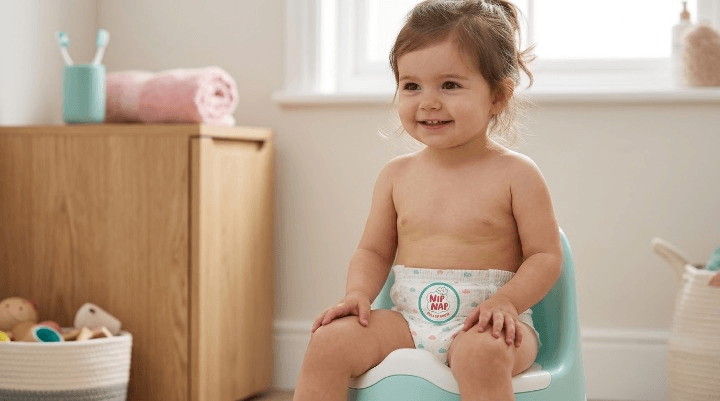
A tape diaper is built to be as secure and leak-proof as possible while a baby lies still, which is close to the opposite of what potty training needs. Pull-up pants close that gap in two specific ways. First, the pull-down, pull-up motion mimics real underwear, so your toddler practices the same physical action they'll use once they're out of diapers entirely, rather than learning an entirely new motion later. Second, most pull-up pants let a toddler feel wetness a little more directly than a heavily absorbent tape diaper does, which helps them start connecting the physical sensation of needing to go with the outcome of an accident — a connection that's central to becoming toilet aware in the first place. NipNap pull-up pants for potty training keep the fit snug enough to prevent leaks during this transition while still giving your toddler that underwear-like independence at each change.
If your toddler is still fairly new to pull-up pants generally, our baby diaper pants Kenya guide covers fit and sizing basics before you get to the training stage.
Signs Your Toddler Is Ready (Not an Age)
There's no single age at which potty training should start, and treating it as a birthday milestone usually backfires — starting before a toddler is developmentally ready tends to draw the whole process out longer, not shorten it. The American Academy of Pediatrics' toilet training guidance frames readiness as behavioural and developmental rather than age-based. Look for these signs instead of watching the calendar:
- Stays dry for two or more hours at a stretch, not just after a nap
- Shows awareness during or right before a bowel movement — a change in expression, going still, hiding
- Can follow simple instructions like "sit down" or "pull your pants down"
- Shows interest in the toilet or in wearing "big kid" pants
- Can communicate the need to go, in words or clearly recognisable signs
If most of these are showing up consistently, your toddler is likely ready to start. If only one or two are present, it's fine to wait a few more weeks and revisit the list rather than forcing the issue.
Regular Diapers vs Potty Training Pants: Quick Comparison
| Aspect | Tape / Regular Diapers | Potty Training Pants Kenya |
|---|---|---|
| Feel vs underwear | Nothing like underwear | Pulls up and down like real underwear |
| Practising the motion | No practice for the toilet routine | Rehearses the exact pull-down, pull-up action |
| Wetness awareness | Heavily absorbent, less noticeable | Lets your toddler feel wetness more directly |
| Independence at changes | Parent does most of it | Toddler can pull them down and up themselves |
| Best used for | Newborn stage, overnight | Active training phase, daytime |
A Realistic Timeline for Kenyan Families
Potty training rarely follows the tidy three-day timeline some books promise, and it's worth setting that expectation from the start. Most toddlers take somewhere between three and six months from the first serious attempt to being reliably dry during the day, with night-time dryness often lagging months behind daytime training — that's normal, not a sign anything's gone wrong. Kenyan households juggling shared caregivers, house help, and different opinions from grandparents sometimes find consistency the hardest part rather than the training itself, so agreeing on the same words, the same potty routine, and the same response to accidents across everyone caring for your toddler matters more than any specific method you choose.
School and daycare schedules are worth planning around too — many Kenyan nurseries prefer some daytime dryness before dropping the diaper requirement, so it's worth asking early rather than assuming term breaks are the best window to start.
Handling Setbacks and Accidents Without Discouraging Your Toddler
Accidents are part of the process, not evidence that training has failed. How you respond matters more than the accident itself: stay neutral rather than frustrated, help your toddler change and clean up together rather than doing it for them silently, and avoid words like "dirty" or "bad" that attach shame to a normal part of learning. A sudden run of regressions after weeks of progress is common around new siblings, house moves, or illness, and usually settles once the disruption passes. If it continues for more than a few weeks with no clear cause, a quick word with your doctor is worthwhile.

Moving From Diaper Pants to Regular Underwear
The shift to regular underwear works best as a gradual handover rather than a single hard switch. Once your toddler is staying dry through most of the day in pull-up pants and asking to use the toilet on their own, try underwear during short, supervised stretches at home first, then extend to outings once accidents become rare.
| Stage | Best Option | Why |
|---|---|---|
| Early training, frequent accidents | Pull-up pants | Full leak protection with an easy pull-down, pull-up motion |
| Consistent daytime dryness | Regular underwear, supervised | Reinforces the sensation of wetness instead of absorbing it away |
| Naps and overnight | Pull-up pants | Night-time bladder control usually lags well behind daytime control |
| Outings and travel | Pull-up pants | Backup protection for a toddler who's still learning, away from home |
Keep pull-up pants for naps, long car journeys, and overnight for as long as needed — night-time bladder control typically develops well after daytime control, sometimes by a year or more, and that gap doesn't reflect on how well daytime training went.
FAQ: Potty Training Pants Kenya
Should I start potty training before or after a new sibling arrives?
Generally, it's easier to avoid starting right before or right after a major disruption like a new sibling. Wait for a calmer stretch where you can be consistent, or pause an in-progress attempt until things settle.
Do boys potty train later than girls?
Some data suggests a slightly later average for boys, but the individual variation within each group is far wider than the difference between them. It's not a reliable planning guide for your specific toddler.
My toddler was doing great and suddenly refuses. What now?
This is a common, normal regression rather than a failure. Ease off the pressure, go back to pull-up pants without comment for a few weeks, and try again once things feel calmer.
Are pull-up pants necessary, or can I go straight to underwear?
They're not strictly necessary, but they reduce mess and stress during the middle phase of training, when accidents are still frequent but your toddler is close to being ready for real underwear.
Potty Training Pants Kenya Parents Trust for the Transition
NipNap pull-up pants give your toddler the underwear-like feel that makes potty training click, with the fit and absorbency to handle accidents along the way.