

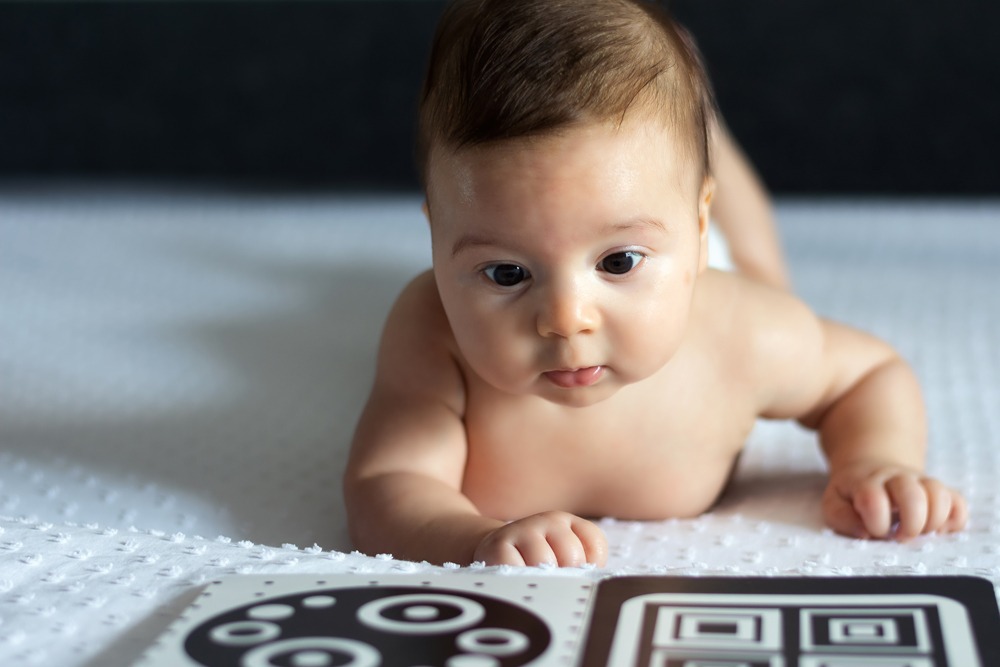
If you’ve ever wondered why black and white patterns are good for your baby’s brain while every nursery shop pushes pastel elephants and rainbow mobiles, you’re not alone — and the science actually backs the plain stuff, at least early on. It’s one of those facts that sounds like a myth until you look at how a newborn’s eyes and brain are wired in the first weeks of life.
Newborn Vision Isn’t What You Think
A newborn can’t see the way you do. Their visual acuity at birth is roughly 20/400 — legally, that’s close to what an adult with poor eyesight sees without glasses. They also can’t perceive subtle colour differences yet; the cells in the retina responsible for colour vision, the cones, take months to fully mature. Rods, the cells that detect contrast and light rather than colour, are far more developed at birth.
That mismatch is exactly why a soft yellow duckling or a pale pink blanket barely registers to a one-week-old. To their underdeveloped visual system, it’s just a grey blur. High-contrast black and white, on the other hand, is the clearest signal their eyes can actually pick up.
What the Contrast Actually Does
Every time a newborn focuses on a sharp black-and-white edge, their visual cortex gets a workout. The brain is building neural pathways based on what the eyes send it, and in the first months, repetition of clear, high-contrast stimulation strengthens exactly those pathways faster than low-contrast, pastel imagery does. Researchers studying infant vision have used black and white cards for decades precisely because contrast — not colour — is what a newborn’s brain can process and respond to first.
It’s not that colour is bad for babies. It’s that colour is mostly wasted on them for the first six to eight weeks, while contrast is doing real developmental work.
When Colour Starts to Matter
Around 2 to 3 months, cone cells mature enough for babies to start distinguishing red first, then green and other colours over the following weeks. By around 4 to 5 months, most babies can see a reasonably full colour range. This is roughly when high-contrast primary colours — bold reds, blues, yellows — become genuinely useful, and pastels start to make a bit more visual sense too. Before that window, though, black and white remains the format their brain is actually built to use.
Practical Ways to Use This
You don’t need to redecorate the nursery in monochrome. A few simple, low-cost additions do the job:
- Black and white board books held 20 to 30cm from baby’s face during awake time
- A high-contrast mobile positioned above the crib, out of grabbing reach
- Patterned swaddles or wraps with bold geometric prints rather than soft, low-contrast florals
- Even everyday items — a striped bag, a checked tea towel — give a newborn something to actually focus on
Even something as ordinary as diaper packaging plays a small part here; it’s part of why we designed our black and white diapers with bold contrast rather than the usual pastel prints — a small, low-effort way to put age-appropriate visual stimulation in front of your baby dozens of times a day, during a change your baby is looking right at you and whatever’s nearby anyway.
Does It Actually Make Babies “Smarter”?
There’s no solid evidence that black and white patterns raise a baby’s IQ, and it’s worth being honest about that rather than overselling it. What the research does support is that high-contrast visual stimulation supports normal, healthy development of the visual pathways during the specific window when a baby’s eyes can use it. That’s a real, useful thing — just not a shortcut to a genius baby, and any brand claiming otherwise is stretching the science.
FAQ
How early can I start showing my baby black and white patterns?
From birth. Newborns can focus on high-contrast patterns within their first days, even before they can track colour or fine detail.
When should I switch from black and white to colourful toys?
Around 2 to 3 months is a natural transition point, as cone cells mature and colour vision starts developing properly. Many parents keep both around rather than switching outright.
Do black and white patterns help with sleep?
Not directly, but calm, focused visual engagement during awake periods can help establish a clearer wake-sleep rhythm over the first few months.
Final Thoughts
The idea that black and white patterns are good for your baby’s brain isn’t a parenting trend — it’s a fairly direct consequence of how newborn vision develops. If you’re curious about our high-contrast diaper range or want advice on what suits your baby’s stage, contact us here. We’ve got more parenting guides like this on our blog, and you can read what other Kenyan parents make of NipNap on our Google profile.