
There's a specific moment every parent in Kenya hits at the supermarket shelf: one pack says "Made in Kenya," the other has a price tag that reflects however many border crossings it took to get there, and you don't know if the extra cost buys you anything real.
It's a fair question, and finding the best diapers in Kenya deserves a fair answer rather than a sales pitch. Here's an honest look at what's different between NipNap, made locally, and the imported brands sitting next to it on the shelf, plus where an imported option might still be the right call for your family.
What "Imported and Relabelled" Actually Means
Not every "international" diaper brand on a Kenyan shelf is manufactured where you'd assume. Some products marketed as premium imports are manufactured in bulk overseas, shipped in, and repackaged or relabelled for the local market, with the import costs, shipping, and currency conversion baked into the shelf price you pay.
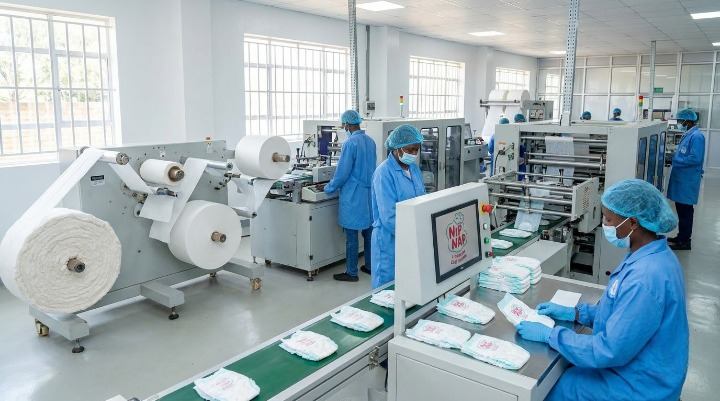
NipNap works differently: it's manufactured start to finish by Sai Pharmaceuticals Kenya Ltd at a facility in Thika, not imported and relabelled. That distinction matters for two practical reasons: pricing and supply. A locally made product doesn't carry the same freight and currency exposure that an imported one does, and it doesn't run out when a shipping container gets delayed at the port.
Material and Technology: What's Actually in the Diaper
This is where a lot of "local vs imported" conversations get vague, so here's what NipNap actually uses, feature by feature.
| Feature | NipNap | What It Does |
|---|---|---|
| Absorbent core | 3D absorbent core, European-grade materials | Pulls moisture away from skin, spreads it through the core instead of pooling |
| Top sheet | Soft breathable top sheet | Wicks liquid down quickly while staying gentle on skin |
| Back sheet | Waterproof but airflow-permeable | Reduces heat and moisture buildup inside the diaper |
| Leg protection | Elastic leg cuffs, dual barrier guards | Seals at the point where most leaks actually happen |
| Waistband | Elastic, adjustable fasteners | Moves with the baby instead of digging in |
| Materials | Chlorine-free, dye-free, latex-free, unscented | Reduces irritation risk on sensitive skin |
| Technology | European materials + German engineering | Same approach used in many premium imported diapers |
The point isn't that "local automatically means identical to imported." It's that NipNap uses the same category of materials and absorption technology that premium imported brands are known for, manufactured locally rather than shipped in.
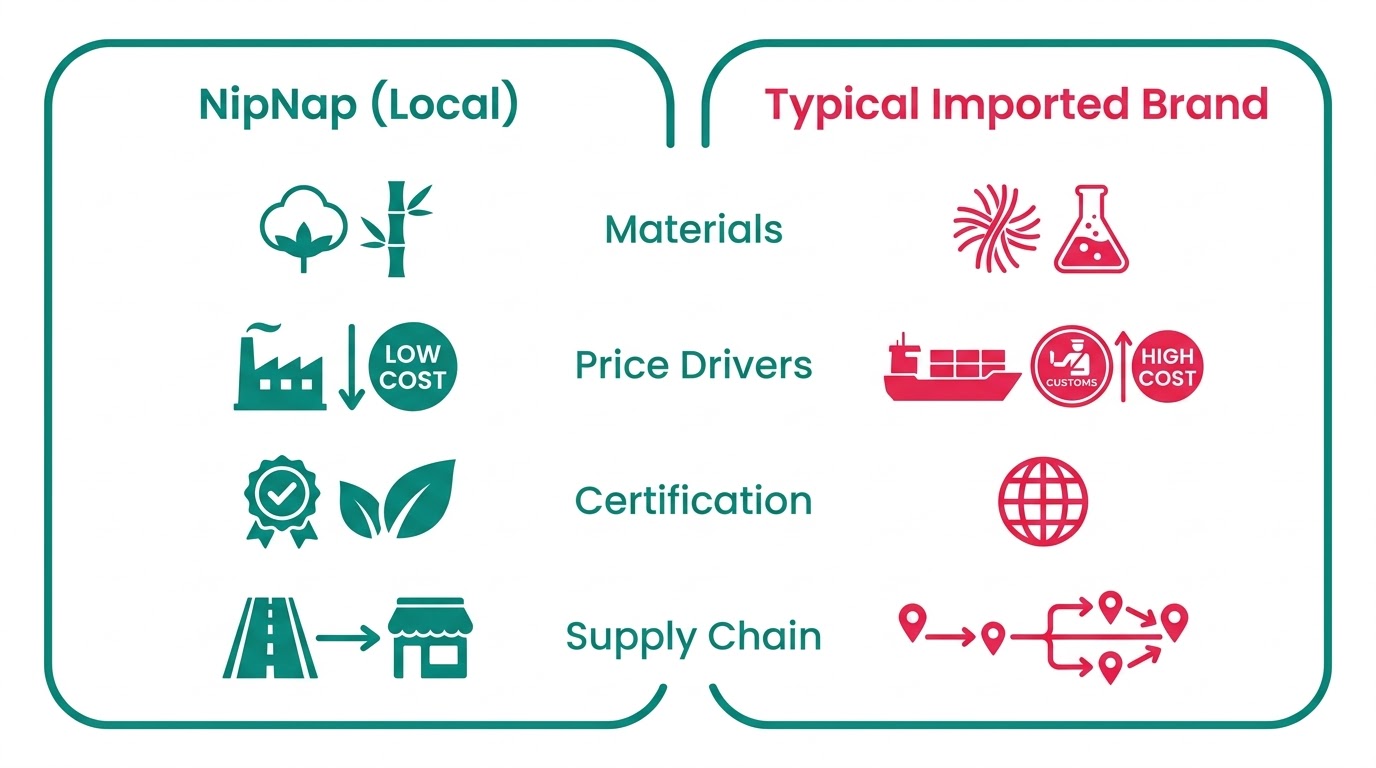
Price Positioning: Where the Cost Actually Comes From
Local manufacturing and import each carry a different cost structure, and it's worth understanding why, rather than just comparing sticker prices.
Kenya's manufacturing sector has been under real pressure from rising input costs, and the Kenya Association of Manufacturers has pointed out that local producers increasingly compete against imported goods made in lower-cost environments with cheaper energy and larger-scale industrial systems. At the same time, KAM has flagged that the accumulation of fees, levies, and import-related charges continues to squeeze the price gap between what a local manufacturer can charge and what an imported product costs to land on a Kenyan shelf.
What this means practically: an imported diaper's shelf price typically reflects manufacturing cost overseas, plus freight, plus import duties, plus currency conversion, plus the local distributor's margin on top. A locally made diaper skips most of that chain. That's the structural reason NipNap can offer European-grade materials and German-style absorption technology at a price point below many imported equivalents — not because the ingredients are cheaper, but because the journey to your shopping bag is shorter.
Certification: Read the Fine Print
Not every product on a Kenyan shelf, imported or otherwise, carries the same local certification, and this is worth checking rather than assuming.
NipNap products are KEBS certified, ISO certified, and CE certified. KEBS certification specifically confirms the product meets Kenya Bureau of Standards requirements for the local market, which isn't automatically guaranteed just because a product is imported from a country with its own strong regulatory system elsewhere. When you're comparing packs, it's worth actually looking for the certification marks on the pack rather than assuming "imported" is shorthand for "more regulated."
Where a Premium Import Might Still Make Sense
Fairness matters more than a sales pitch, so it's worth being upfront: there are situations where an imported diaper might genuinely be the better fit for a specific family.
- A baby with a diagnosed sensitivity to a specific ingredient that a particular imported brand's formulation happens to avoid, on a paediatrician's specific recommendation
- Brand loyalty from a previous country of residence, where a family has years of consistent experience with one specific product
- Specialty formats not yet offered locally, like certain overnight-specific designs some imported brands specialise in
None of these are reasons to distrust local manufacturing broadly. They're just genuine, specific scenarios where a particular imported product might edge out a local one for a particular baby, the same way any two products in any category can suit different people differently.
The Honest Bottom Line
For the vast majority of Kenyan families, the practical differences that actually affect daily life — dryness, fit, skin comfort, price, and supply reliability — come down to manufacturing quality and design, not the country of origin printed on the box. NipNap combines materials and absorption technology comparable to premium imported brands with local manufacturing that keeps pricing more predictable and stock more consistent, since it isn't riding on a shipping schedule from overseas.
If you're deciding between NipNap and an imported pack at the shelf, the more useful question isn't "which one is imported," it's "which one actually fits my baby's size correctly and stays dry through the stretch of time I need it to." Get the sizing right first (our Baby Nappies Kenya guide covers that), and the rest of the comparison usually settles itself.
For more on how local manufacturing shapes pricing and availability across the category, see our best diapers in Kenya guide.
Best Diapers In Kenya? Premium Materials, Local Price, Zero Shipping Delays.
See why thousands of Kenyan parents chose NipNap over imported brands.
FAQ: NipNap vs Imported Diapers in Kenya
Are locally made diapers really as good as imported ones?
For most families, yes. The materials and absorption technology used in NipNap's diapers are comparable to what premium imported brands use, the main difference is that local manufacturing removes the freight, duty, and currency costs baked into an imported product's price.
Does "Made in Kenya" mean lower quality?
No, and this is a common misconception. NipNap holds KEBS, ISO, and CE certification, the same categories of certification many imported brands rely on to demonstrate quality and safety standards.
Why are some imported diapers more expensive if the materials are similar?
Import costs, shipping, currency conversion, and distributor margins all add to the shelf price of an imported product before it reaches you, on top of whatever it cost to manufacture overseas in the first place.
Should I switch from an imported brand I've always used?
If your baby is doing fine and you're happy with the cost, there's no urgent reason to switch. If cost or availability has become a pain point, trying a pack of NipNap alongside your current brand is a low-risk way to compare fit and absorbency for yourself.
Where can I buy NipNap diapers in Kenya?
NipNap is available at Mydawa, Carrefour, and Greenspoon, or you can order directly through WhatsApp for delivery.